
Stories
IYABO
F
I like stories, interesting ideas and making things. Usually figuring things out as I go.
November 11, 202610 min read7 views
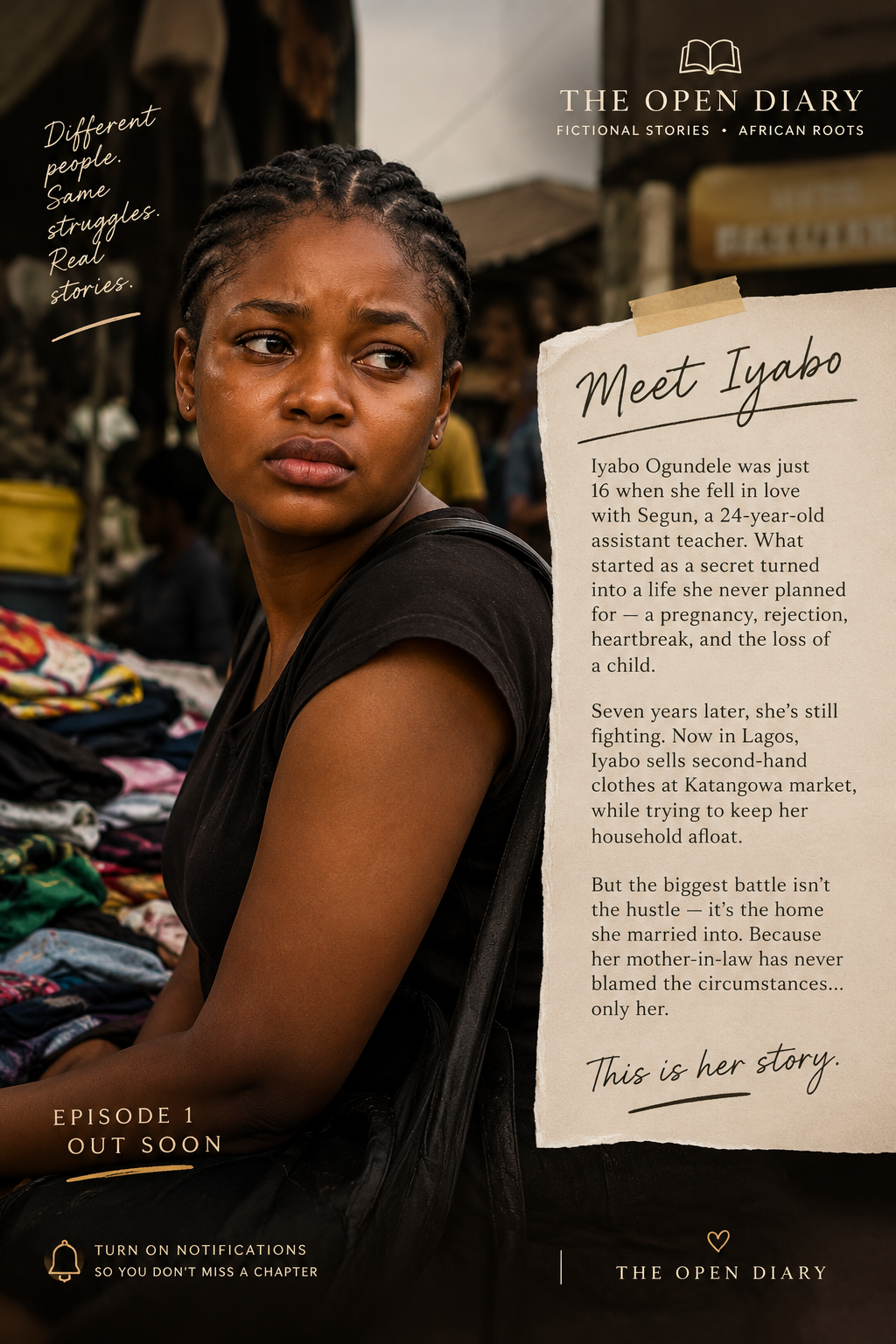
Episode One
“E no get venom again. Nothin’ go do you, Iyabo.”
That was what Segun’s mother said, her voice smooth with the kind of certainty that left no room for argument.
She stood beside the wooden counter in her small room, one hand resting on her waist, the other pointing towards a thick glass bottle of gin. Inside it was a pale greenish snake, its body curled around itself, its lifeless eyes staring through the cloudy liquid as though it had unfinished business with the living.
I stared at the bottle.
Then I looked at Mama.
Then back at the bottle.
Ọlọ́run mi. So na snake remain?
My stomach turned. I could already imagine the bitter taste of gin crawling down my throat, carrying the thought of that dead creature with it. A wave of nausea rose in my chest.
“Ma, must I drink it?” I asked quietly.
Mama’s eyebrows shot up.
“E ma gbo oro jati jati… Iyabo, wetin you mean by that question? You think say I bring you come here because I no get better thing to do?”
“No, Ma. I was only asking—”
“Asking what? For seven years now, you never born one child for my son. Seven years! And you still get mouth to dey ask questions, ó mà sè o!”
I lowered my eyes.
There was a time I would have argued. A time I would have asked why her son’s betting slips received more attention than his responsibilities as a husband. A time I would have reminded her that a marriage required two people, not one woman carrying the burden while everybody pointed fingers at her womb.
But those days were becoming fewer.
In the house of Ogundele, a woman could be hungry, exhausted, insulted, and even forgotten. But if she had no child, that was the one thing nobody would allow her to forget.
Mama stepped closer, her wrapper rustling against the hem of her blouse.
“Iyabo, se o gbo?” Do you hear me?
I swallowed.
“Mo gbọ́, Ma. I hear you.”
“Oya mu!” Drink it
I looked at the bottle again.
Oloriburuku!wicked woman If na your son body we wan use experiment,you go force am?
The words remained trapped behind my teeth.
Instead, I bowed my head.
“Okay, Ma.”
My name is Iyabo Ogundele, and in the house of Ogundele, a woman’s voice is only as loud as the children she bears.
But before I became the woman staring at a dead snake inside a bottle of gin, I was once a girl who believed she had been given a lucky escape from poverty.
⸻
People in Ilu Oke thought I was lucky.
Imagine—a small SS1 girl like me getting married to a government teacher! In those days, that was the kind of news that made neighbours abandon their cooking to come and gist at the gate.
“Ah, Iyabo has tried o!”
“God has remembered that girl.”
“Her father must be very happy. At least, somebody will take care of her.”
Everybody had something to say.
Nobody asked whether I was ready.
I was barely sixteen when my belly started showing for Segun.
My father was the only parent I had. He wasn’t a rich man, but he tried. He sold building materials in the village and somehow managed to keep food on our table and my school fees paid. He was the kind of man who could go hungry and still insist that his daughter must eat.
When he discovered I was pregnant, something in him broke.
I still remember the way he looked at me that afternoon. He didn’t shout at first. He simply sat on the wooden bench outside our house, staring at the ground as if he was searching for the right words among the red dust.
Then he asked me one question.
“Iyabo, se nkan tò fe leleyi?” Iyabo is this what you want?
I had no answer.
He drove me out of his house.
Seven months later, the old man died.
People said it was heartbreak. Others said his blood pressure had been rising for a while. I was too broken to ask questions.
When the news reached me, I cried until I could barely breathe. That same night, I lost the baby.
My father was gone.
My child was gone.
And the life I had imagined for myself disappeared before I could understand what had happened to it.
After that, people began to speak about my womb as though it had become a public meeting ground.
At first, they said I needed time to recover. Then they said I needed prayer. After a while, the whispers became accusations.
Seven years later, I was still waiting for a child.
Seven years of counting months, swallowing bitter herbs, visiting prayer houses, and pretending not to notice the pity in people’s eyes.
Seven years of wondering whether my body had failed me or whether life had simply dealt me a hand I didn’t know how to play.
And through it all, Segun remained my husband.
⸻
We moved to Lagos after our wedding, settling into one tight face-me-I-face-you room in Onipanu.
If you have never lived in that kind of place, let me explain it to you.
Your neighbour’s cooking smoke is your cooking smoke. Their argument is your argument. When one baby cries at midnight, three other babies usually join the choir. And if the woman in the next room decides to pound yam at six in the morning, you will wake up whether you like it or not.
Privacy is a luxury. Peace is a prayer point.
But I didn’t mind it at first.
I was young, married, and determined to make something out of my life. I thought that if we worked hard enough, we would eventually move into a proper apartment, buy furniture that matched, and perhaps have two or three children running around the house.
I imagined Segun coming home from school with stories about his students while I prepared dinner.
I imagined us growing old together.
Ah, Iyabo. Too naive! you really believed life was a Nollywood film.
Segun was an assistant government teacher when I married him. I thought it was an honourable job. The salary wasn’t much, but I believed a man who worked hard and feared God could build a decent life with what he had.
Then, one afternoon, he came home and announced that he was leaving teaching.
“Teaching is small money,” he said, dropping his bag beside our mattress. “I have bigger plans.”
I was ironing one of his shirts at the time.
“Bigger plans like what?”
He gave me that confident smile I had once found attractive.
“Iyabo , you don’t understand these things. Just give me time.”
That was the kind of thing Segun would say when he wanted to sound important. He had a habit of borrowing confidence from people who had more sense than him.
I should have known then.
But love, they say, is blind. In my own case, love needed glasses and still refused to see.
Do you know what those bigger plans were?
Sitting at the junction from morning till evening, playing Baba Ijebu and betting on Nairabet.
Every day, the same plastic chair. The same group of men. The same arguments about odds and winning numbers. Sometimes, he would return home excited because he had won a little money. Other times, he would enter the room with a face long enough to touch the floor.
And guess who suffered when he lost?
Me.
“Babe, give me small money. I will pay you back tomorrow.”
Tomorrow became next week. Next week became whenever God remembered us.
Meanwhile, our landlord wasn’t interested in Segun’s dreams. The woman selling food downstairs didn’t accept promises. Electricity bills didn’t disappear because a man had a business idea.
Somebody had to work.
So I became that somebody.
Every morning, I would travel to Katangowa market, searching for good okrika clothes I could buy cheaply and resell for a little profit. I learned how to identify quality clothes by touch, how to bargain until a trader threatened to pour water on me, and how to smile even when my feet were aching.
I sold clothes to women in the neighbourhood, took orders from church members, and sometimes carried my goods from one street to another.
The money was never enough, but I stretched it.
Rent. Food. Electricity. Transport. Soap. Cooking gas.
And Segun’s transport fare to go and bet.
Oloriburuku! Àlapa ma se ise agbaya!
A grown man who couldn’t carry his responsibilities.
This man could sit in one place for ten hours calculating how much he would win, but ask him to calculate our house rent, and suddenly his brain would develop a fault.
Sometimes, I would watch him sleep and wonder what exactly I had married.
A husband?
Or another child God had mistakenly assigned to me?
Ọlọ́run mi, kí ni mo ṣe tí te mi fi ri bayi?
What did I do to deserve this?
The worst part was that he never seemed ashamed.
He could eat the food I struggled to buy, stretch his legs on our mattress, and ask me for money with the confidence of a man who had paid all the bills.
And yet, deep inside me, there was a small voice thanking God that I didn’t have a child for him.
How would I feed a baby when I was already feeding a full-grown, useless man?
It was a wicked thought, perhaps.
But hunger and disappointment can make even a good woman think terrible things.
⸻
Unfortunately, Segun’s mother would rather swallow a stone than blame her son.
To Mama, her only son was a golden child. If he woke up late, somebody had disturbed his sleep. If he lost money gambling, somebody had brought bad luck into his life. If he couldn’t pay his bills, it was because his wife had failed to support his destiny.
And if he had no child?
Well, that one was my personal crime.
“Na your wicked spirit close that your womb!” she would shout, pointing a sharp finger at my face. “You kill your own father with bad behaviour, now you wan kill my son name join?”
The first time she said it, I cried.
The second time, I cried in private.
After a while, I learned to keep my face still.
What was the point of crying? Would tears make her see sense? Would they make her look at her son and ask why a man who had abandoned his job was blaming his wife for their circumstances?
Never.
For Mama, Segun could do no wrong.
She carried me to white-garment churches, dragged me to Alfa houses, and made me drink one bitter concoction after another. Some tasted like boiled roots. Others smelled like something that should have been buried rather than swallowed.
Each time I hesitated, she reminded me of my father’s death.
As if I hadn’t spent enough nights wondering whether he had forgiven me before he died.
As if I needed another person to remind me of the baby I had lost.
Once, after a particularly bitter mixture, I spent the entire evening vomiting behind our room. Segun watched me from the doorway.
“Why didn’t you just drink it properly?” he asked.
I looked at him.
That was all I did.
I looked at him, and something inside me went quiet.
Because how could I explain to a man who couldn’t even defend his wife that I was tired of being treated like a broken machine?
How could I tell him that I was afraid of my own body, that every month brought another reminder of what I had lost, that sometimes I lay awake wondering if I would ever hear a child call me Mummy?
He wouldn’t understand.
Or perhaps he simply didn’t want to.
And so, I kept quiet.
Until that afternoon.
⸻
Now, standing in Mama’s room, I stared at the snake floating inside the bottle.
Outside, a neighbour was calling her child to come and eat. Somewhere down the passage, a radio blared an old Yoruba song. The smell of fried pepper drifted in from somebody’s kitchen.
Life continued as though nothing unusual was happening.
But inside that small room, my entire worth was being measured against an empty womb.
“Drink am, Iyabo,” Mama said again. “You want make I beg you?”
I looked at her.
Then I looked at the bottle.
And for the first time that afternoon, I wondered what would happen if I simply refused.
What would she do?
What would Segun do?
Would anybody, for once, ask why I was the one expected to suffer for everything that had gone wrong in our marriage?
My lips parted.
But the words didn’t come.
Instead, I lowered my head, the way I had done so many times before.
“Okay, Ma.”
And that was how I found myself standing in a cramped Lagos room, preparing to drink a dead snake in gin because the people who called me family had convinced me that my greatest failure was being unable to give them a child.
I looked at the bottle one last time.
Ọlọ́run mi, help me.
Because if this was what marriage had become, I didn’t know how much more of it I could survive.
#lagos
#love
#secondchance
#freedom
Reviews (0)
Join Creative Garden to post a review.