
Book Chapters
THE WRONG IDEA OF MASCULINITY
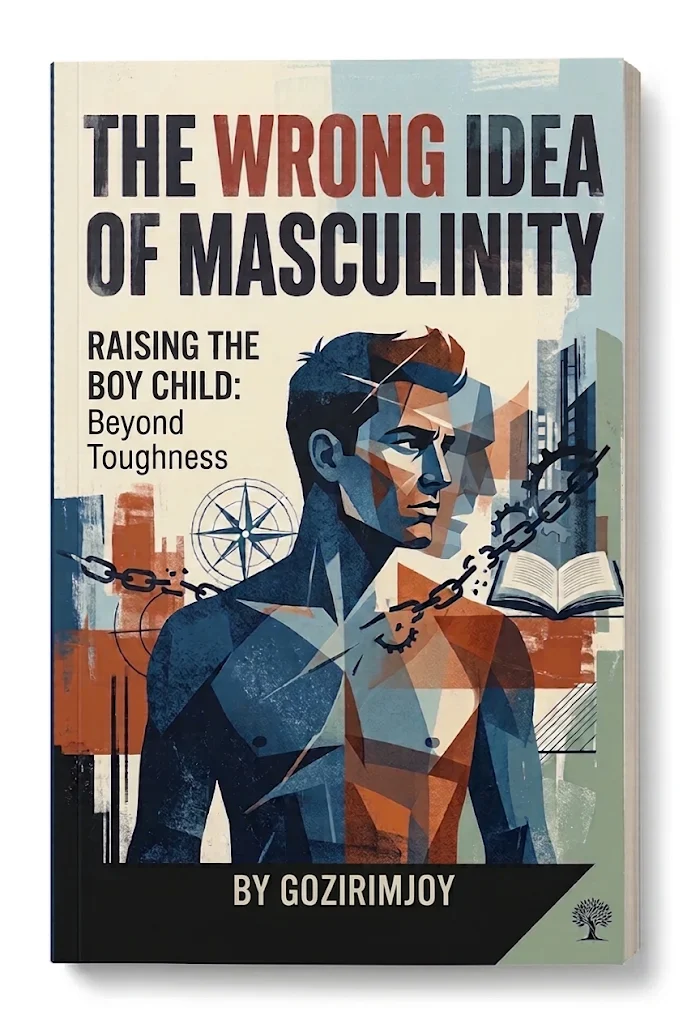
THE FORGOTTEN HALF OF PARENTING
We talk so often about raising the girl child that somewhere along the way, we forgot to ask — what about the boy child?
Family is the closest unit to God’s heart. The Bible says in Proverbs 22:6, “Train up a child in the way he should go, and when he is old, he will not depart from it.” Notice, it says a child — not a boy child or a girl child. Both are included.
Yet, in today’s society, families and communities have built different standards for raising boys and girls. We have been conditioned to believe that a boy should be raised one way and a girl another. That a girl deserves tenderness, guidance, and emotion, while a boy only needs discipline and toughness. In doing so, we have unknowingly taught the boy child the wrong version of masculinity — and the girl child the wrong version of femininity.
GOD’s ORIGINAL BLUEPRINT
When God created humanity, He gave both Adam and Eve purpose and partnership. Adam was not created to rule by dominance but to lead in stewardship, wisdom, and love. The instruction God gave Adam — “to tend and keep the garden” (Genesis 2:15) — was an act of care, not control. This means that from the beginning, manhood was meant to carry responsibility, not rigidity. Boys should be raised to understand that leadership begins with service and that strength without tenderness becomes destruction.
In Ephesians 6:4, the Bible warns fathers: “Do not provoke your children to anger, but bring them up in the discipline and instruction of the Lord.” This scripture reminds us that discipline must be balanced with love, guidance, and example. A boy who only fears correction but never experiences compassion will grow into a man who confuses fear with respect.
TEACHING THE BOY CHILD EMOTIONS AND EXPRESSIONS
Children are gifts to society. Whatever you build into them is what they will become. If you raise an emotionally intelligent boy, he will grow into a man who leads with understanding and compassion. But if you raise a boy who is taught never to cry, never to speak, and never to feel, he will grow into a man who believes silence is strength and dominance is love.
Many fathers unconsciously repeat what they experienced — “Don’t cry,” “Be a man,” “Figure it out.” But true manhood is not the absence of emotion; it is the mastery of it. Even Jesus wept (John 11:35). The Son of God Himself expressed grief, compassion, and empathy. That means emotions are not weakness — they are proof of humanity.
Imagine if even half of the emotional care, patience, and mentorship poured into girls were also poured into boys. We would raise a generation of men who understand love, respect, and responsibility just as deeply as women do.
RELEARNING MASCULINITY
Too often, the girl child is carefully groomed — she’s taught how to cook, clean, nurture, and care for others. Meanwhile, the boy child is told, “He’ll be fine.” But he’s not always fine. He, too, is human. He needs to be taught how to express himself, how to be present, how to communicate, how to love. He needs to be shown that confidence doesn’t mean intimidation, and that leadership isn’t about control.
We do not need to raise simps or strip boys of strength. We need to raise balanced men — strong, yet kind. Firm, yet gentle. Men who understand that headship is not tyranny, but guidance in love.
1 Corinthians 11:3 says, “The head of every man is Christ.” Headship is therefore not about ego or superiority — it’s about responsibility, accountability, and love. Jesus led His disciples not by domination but by service. He washed their feet (John 13:14–15) and taught them that “whoever wants to be great among you must be your servant.” That is the model of true manhood. That is the kind of leadership we must raise boys to understand — one that reflects Christ’s humility, patience, and purpose.
THE COST OF NEGLECTING THE BOY CHILD
Unfortunately, many boys grow up without such modeling. Their fathers were also raised with the “don’t cry” mentality, and so the cycle continues. These boys grow up bottling emotions they were never taught to name, and the result is outbursts — physical, verbal, or emotional — that harm others and themselves.
We’ve taught them that being a man means raising your voice instead of reasoning, acting tough instead of being honest, and walking in entitlement instead of gratitude. Some men have never learned that it’s okay to say “thank you” for a meal, even one they paid for. They were not taught humility in love.
BALANCING THE SCALES
While the girl child is groomed to be a wife, the boy child should be groomed to be a husband — a partner, a father, a team player. While girls are taught to nurture, boys should be taught to protect and participate.
No, men and women are not meant to compete for position — the man remains the head. But headship is not dominance; it is leadership through love, patience, and example. The man’s strength should not suppress but support. His authority should not control but cover.
RAISING “WHOLE” BOYS FOR A “WHOLE” SOCIETY
The boy child deserves the same attention, care, and celebration given to the girl child. He is not a superhero — he is human. He bleeds, he breaks, he gets tired, he feels pain, and yes, he cries.
If he can eat, he should learn to cook.
If he lives in a house, he should learn to clean.
If he receives care, he should know how to give it.
If love is shown to him, he should learn to express it in return.
To raise better men, we must model the character of Christ — His discipline, His compassion, His humility, and His love. Christ led through service. He commanded strength but displayed empathy. He carried authority but exercised restraint.
If our boys grow up with that same balance — heart and strength, truth and grace — the world will be filled with men who build, not break; who protect, not provoke; and who lead, not lord over others.
It’s time to raise the boy child with intention. The world doesn’t just need strong men; it needs whole ones!
—✍️GozirimJoy
The wrong idea of masculinity .pdf
PDF · Creative Garden Reader
Open in Creative Garden Reader
The wrong idea of masculinity .pdf
Reviews (0)
Join Creative Garden to post a review.