
Book Chapters
The War the was not His
O
Historical fiction author, digital content creator, and HR consultant. I explore the intersections of history, identity, and visual branding,crafting compelling narratives across prose, digital media, and brand strategy. Always open to collaborating on story development.
October 15, 20266 min read2 views
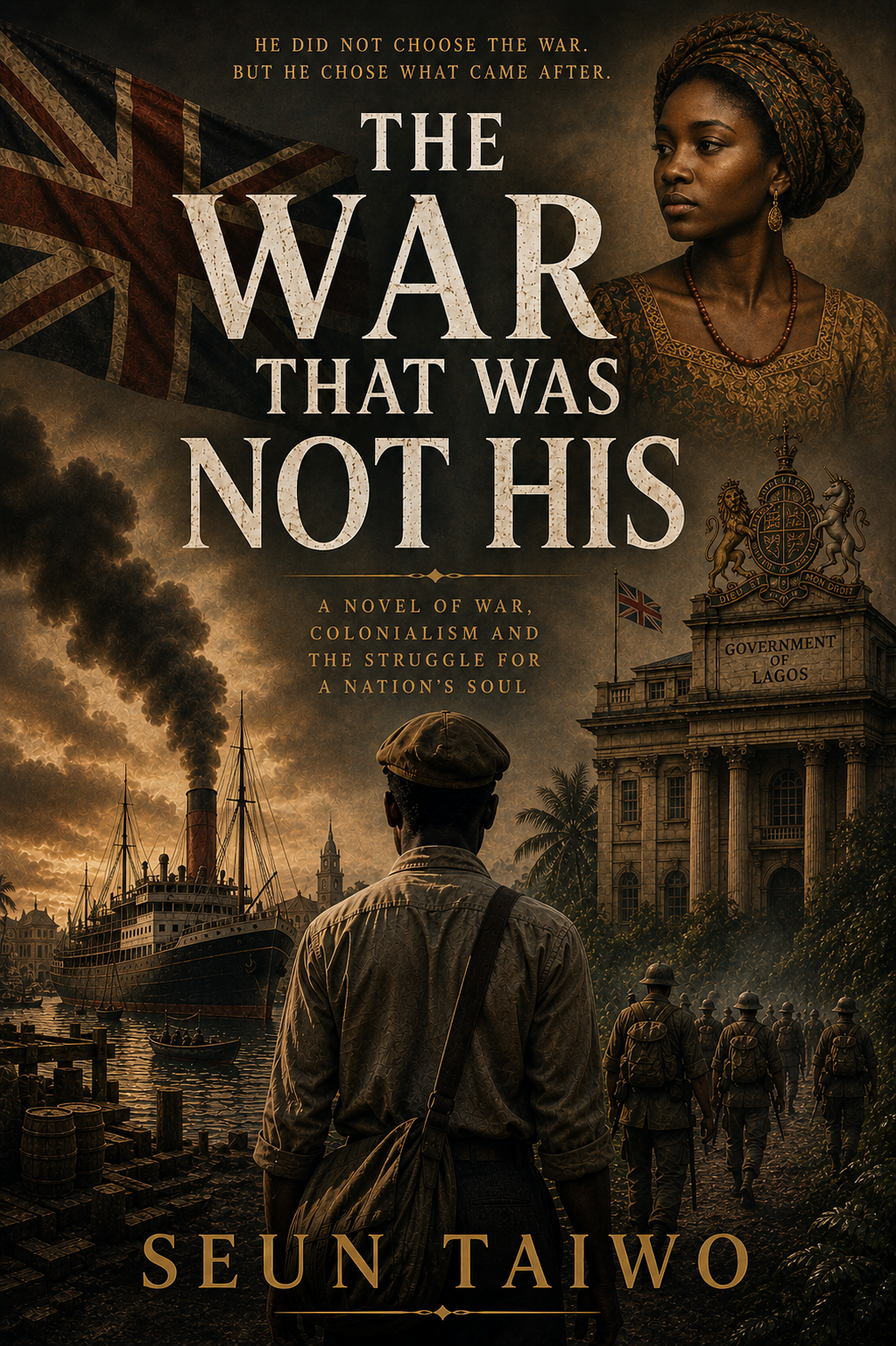
Chapter 1: The Salt on the Lagoon
The morning air in Epetedo smelled of woodsmoke, ground palm kernels, and the damp mud of the lagoon.
Ola buttoned his clean cotton shirt. The cloth was thin and soft from many years of his mother washing it. Across the small open yard, his mother, Adunola, sat on a low wooden stool. She blew gently on a piece of charcoal until a small red spark caught the dry coconut husk in her stove.
"You are going early today," she said. Her voice was calm and low. She was a woman who had seen much trouble, but her face never showed panic.
"A big boat carrying fruit and timber is coming in at seven," Ola said, picking up his ledger book. "If I am not at the dock before the white supervisor arrives, he will make us wait outside the gate all morning under the hot sun."
Adunola reached into the pocket of her wrapper and brought out a small piece of dried bitter kola. She held it out to him.
"Chew this," she said. "The cold air on the lagoon in the morning is not good for a young man who has not eaten breakfast."
Ola took the nut and bit into it. The bitter taste filled his mouth. It was the same taste his father used to keep in his mouth whenever he walked down to the waterfront to trade with the European merchants.
His father had died when Ola was just fourteen, but Ola still remembered his words clearly.
"Look at the heavy leather boots on their feet, Ola," his father had told him one evening while they sat outside watching the rain fall on the tin roofs. "A man who comes to build a good house for you does not wear heavy boots that allow him to run away when the mud gets deep. They do not come here because they love us. They come for the palm oil, the wood, and the cocoa. When those things are gone, they will take their ships and go home."
His father could not read or write, but he knew how the merchants worked. He had made sure Ola went to the mission school on Broad Street. He did not send him there to adopt foreign ways, but so Ola could read the numbers in their big trade books and protect himself.
Ola stepped out into the street. Epetedo was already busy. Women carrying wooden trays of fried bean cakes called out to people walking by. Children ran between the houses, carrying buckets of water on their heads. The houses here were built close together. Some were made of mud with zinc roofs, while others were built of high wooden frames by families who had returned from Brazil and Sierra Leone many years ago.
Ola walked down toward the waterfront.
In 1939, Lagos was a city divided into two different worlds by water, laws, and skin color.
At the top of the social ladder were the British colonial administrators and European merchants. They lived in the quiet, green neighborhood of Ikoyi and along the paved sweep of the Marina. Their houses were large, two story wooden and brick buildings with wide verandas to catch the sea breeze, surrounded by high fences and neat lawns. The government provided them with electric lights, clean pipe borne water, tarred roads, and armed police to guard their gates.
Directly below the British officers were the educated local elite. These were the lawyers, senior clerks, mission teachers, and clergymen who lived around Broad Street and Lagos Island. Many wore European suits, attended church every Sunday, and believed that following British rule was the only way to modernize the country.
At the very bottom were the ordinary people of Lagos. These were the dockworkers, market women, fishermen, and laborers living in neighborhoods like Epetedo, Isale Eko, and Obalende. In these areas, the colonial government built very little. The streets were unpaved dirt tracks that turned into thick red mud during the rainy season. The gutters were open trenches, and hundreds of families shared single neighborhood water taps.
The entire city was run through the Colonial Secretariat on the Marina. From that white walled building, the Governor General issued orders, set taxes, and controlled the trade ports. Nigerian workers did the heavy labor by carrying cocoa sacks, driving trains, and typing letters, but every decision and every profit flowed directly back to the government offices and shipping companies in Great Britain.
Ola reached the jetty where the wooden passenger boat, the Eko Princess, sat in the grey water. Its diesel engine made a loud, heavy thumping noise.
Ola paid his two pence coin and sat near the edge of the boat. The ferry was packed with workers, including clerks in neat shirts, market women with big baskets of smoked fish, and young men going to work at the railway stations in Ebute Metta.
As the boat pushed out into the deep water, Ola noticed a young woman sitting near the front.
She held a small church book in her lap. Her headwrapper was tied neatly, and her face was calm as she looked out over the lagoon.
Suddenly, a large speedboat carrying white officers passed close by, making big waves in the water. The ferry rocked heavily to one side. A basket of dried yams near her feet tilted and began to slide across the deck. Ola reached out quickly and caught it before it could fall into the water.
The young woman turned around fast, her hand over her chest.
"Ah. Ẹ ṣe o. Thank you," she said softly.
"It is the big boats," Ola said, moving the basket back to a safe spot. "They drive fast and do not care about small ferries."
She looked at him, noticing his ink stained fingers and the record book under his arm. A small smile appeared on her face.
"You sound like someone who works with ships every day," she said.
"I am Ola," he said politely. "I work as a clerk at the Apapa docks."
"My name is Sade," she said. "Sade Folayan."
Ola recognized the name immediately. Her father was Catechist Folayan, a well known leader at the mission church. He was a man who believed strongly in the British administration and often told his congregation that the colonial government brought order and peace to the land.
"Your father leads the prayers at the mission church," Ola said.
Sade’s smile went away slightly, and she sat up a little straighter. "Yes. He teaches us to respect those in authority so there will be peace."
"My father used to say that peace is good, but fairness is better," Ola said quietly. "The government collects taxes from everyone in Epetedo, but they only build good paved roads where the white officers live."
Sade looked at him carefully. She did not look angry, but her eyes were sharp. "You have strong words for a young man with a ledger."
"They are not just words," Ola said, opening his book to show the rows of numbers. "The numbers show how many tons of oil leave this port every week, and how little stays behind to help the people who carried the sacks."
For a long moment, neither of them spoke. The only sound was the splash of the grey lagoon water against the side of the boat. Sade looked at Ola’s calm face and the serious look in his eyes.
"Will you be taking this same ferry back home this evening?" she asked softly as the boat approached the Apapa pier.
Ola looked at her. "If my work at the dock is finished by five, I will be here."
Sade gave a small nod, held her church book close, and stepped off the boat onto the wooden dock ahead of him.
Ola watched her walk toward the road leading to the school. Behind her, high above the roofs of the dock offices, the British flag fluttered in the sea wind over the busy port.
Reviews (0)
Join Creative Garden to post a review.